



Google Ads account structure: best practices & complete guide
- 06.03.2026
- 1 views
- 7 min

Key Takeaways:
- a well-structured Google Ads account directly impacts Quality Score, CPC, conversions & algorithm learning;
- separate campaigns by intent, product, margin or funnel stage to avoid mixed signals & inefficient optimization;
- clear structure simplifies scaling;
- use 2–3 ads per ad group & continuously refine based on performance data.
A properly built Google Ads account is the foundation of profitable paid traffic. Many businesses focus on ads and bids, but ignore structure. In reality, a well-structured Google Ads account directly affects learning algorithms, budget control and conversion results.
This Google Ads guide explains how to build a logical structure that supports performance. Whether you are new to running Google Ads or optimizing an existing campaign and account, structure determines efficiency, clarity and scale.
This comprehensive guide will walk you through specific structure, keyword grouping, ads and landing pages alignment and optimization principles that protect profitability.
How Google Ads account structure works in practice
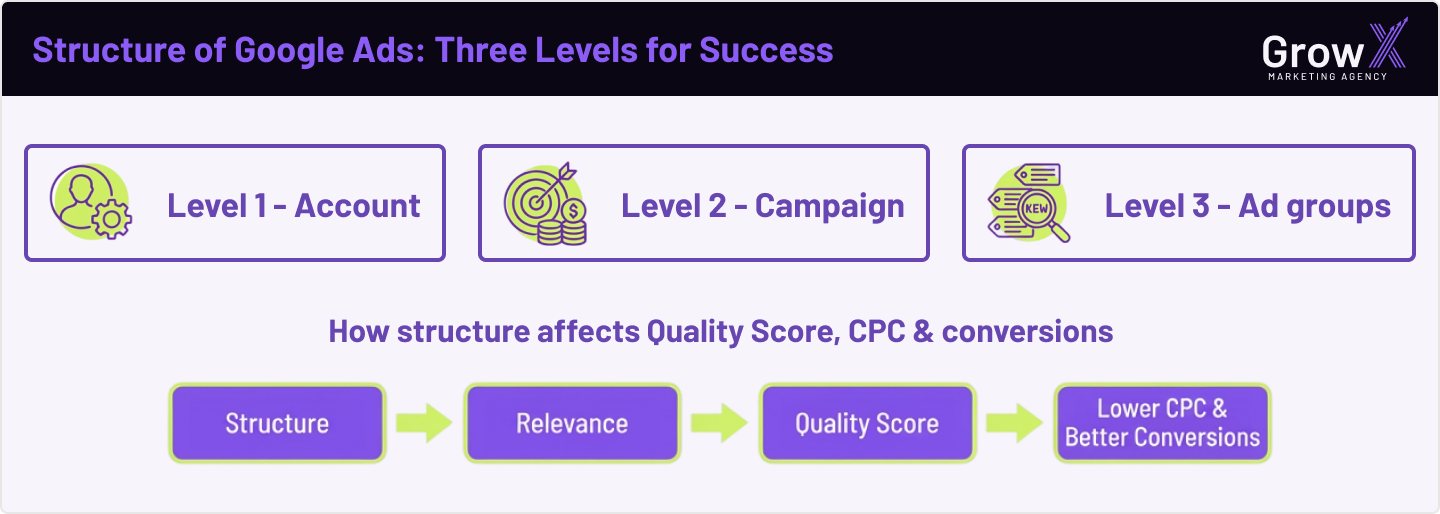
The structure of your Google Ads has three core levels. Each level controls different settings and influences performance in specific ways. When built correctly, this hierarchy helps campaigns run efficiently and makes optimization easier.
In practice, structure defines how budgets are distributed, how bidding strategies operate and how relevance is maintained. A clear structure allows Google’s algorithm to receive consistent signals, which improves stability and results over time.
Account, campaign & ad group levels
Level 1 – Account
The Google Ads account contains global settings such as currency, time zone, billing data, language and linked platforms. The account name should reflect the business clearly, especially when managing multiple clients.
Level 2 – Campaign
Each campaign has its own budget, bidding strategy, location targeting and campaign type. This is where you define whether it is a search campaign, Display or Performance Max.
At this level, you control how much you are willing to spend and what objective the campaign should optimize for. Separate campaigns allow clearer budget control and prevent different goals or products from competing within the same setup.
Level 3 – Ad groups
Ad groups contain keywords, ads and landing pages aligned with one specific search intent. This level determines how relevant your ads appear to users.
When you structure your ad groups properly, keywords are closely related, ad copy reflects those keywords and landing pages match expectations. This increases Quality Score, improves CTR and gives you better performance control.
How structure affects quality score, CPC & conversions
A well-structured Google Ads account improves ad relevance. Higher relevance increases Quality Score. Higher Quality Score reduces CPC and improves conversion potential.
When keywords, ads and landing pages match tightly, Google’s algorithm receives clear signals. Mixed signals lower CTR, raise CPC and reduce efficiency.

Why structure determines control over performance
Structure controls budget allocation and bidding logic. If campaigns mix different goals or products, optimization becomes average instead of strategic. Clean structure gives control over budget, performance tracking and scaling. It prevents internal competition.
How campaign structure reflects business goals
Campaigns must reflect real business objectives. If structure ignores business logic, performance suffers. Google’s algorithm optimizes based on signals it receives. When goals are unclear, results become inconsistent and harder to scale.
A strong structure mirrors how the business generates revenue. It separates priorities, protects profitable products and ensures budgets align with strategic importance.
Structuring campaigns by intent, product or funnel stage
Campaigns can be separated by:
- search intent;
- product or service category;
- funnel stage.
Segmenting by intent allows you to allocate more budget to high-converting queries. For example, transactional keywords should belong in a dedicated search campaign focused on conversions. Informational queries should not compete for the same budget because they serve a different purpose.
Separating campaigns by product or funnel stage also improves bidding accuracy. When each campaign has a clear goal, optimization becomes more precise and performance more predictable.

When separate campaigns are required for budget or bidding
Separate campaigns are required when:
- products have different margins;
- different regions require separate budgets;
- different bidding strategies are needed.
Mixing high-margin and low-margin products forces Google to optimize for average performance.
Why mixing goals inside one campaign hurts performance
If one campaign targets both brand awareness and conversions, the algorithm receives conflicting signals. As a result, CTR drops, CPC rises and conversions decrease. Clear goals per Google Ads campaign improve optimization accuracy.
How ad groups & keywords affect relevance & results
Ad groups and keywords are the backbone of a well-structured Google Ads account. They determine how closely your ads match user intent, which directly affects CTR, quality score and conversions. Proper organization ensures that each ad group targets a specific theme, aligns with the right landing page and uses negative keywords to filter irrelevant traffic. This structure not only improves ad relevance but also maximizes the efficiency of your campaigns and budget.
Keyword grouping logic & impact on ad relevance
Keywords inside one ad group must share the same intent. For example, a group targeting “buy black sneakers” should include closely related terms only. Headlines and descriptions must include those keywords. This improves CTR and quality score.
Structure your ad groups so that each group represents one clear query theme.
Aligning ads with landing pages for maximum performance
Ads and landing pages must match perfectly. If the ad promises a specific product, the landing page must show that exact product. Each ad group should lead to one relevant landing page. Misalignment reduces trust and conversions.
Always create 2–3 ads per ad group for testing. Over time, pause weak ads and keep top performers.
Implementing negative keywords effectively
Negative keywords prevent irrelevant traffic. Without them, campaigns waste budget on non-target queries. Maintain and update your negative list regularly. This prevents campaigns inside the same Google Ads account from competing with each other.

How account structure supports optimization & scaling
A well-organized Google Ads account is key to efficient management and long-term growth. Proper structure makes reporting clear, highlights high-performing campaigns and ensures budget, and bid adjustments are data-driven. It also provides a solid foundation for scaling, as profitable ad groups can be expanded while underperforming ones are paused, keeping campaigns efficient and results predictable.
How clean structure simplifies reporting & insights
A structured account allows you to clearly see which campaigns, keywords, or ads generate profit. Without structure, reports become confusing. With structure, performance insights become obvious.
How structure affects optimization
Logical structure allows you to adjust bids where results justify it. You can scale profitable ad groups and pause inefficient ones quickly. When running Google Ads, clarity saves time and protects budget.
Common traits of scalable accounts:
- clear separation by goal;
- logical keyword grouping;
- strong alignment between ads & landing pages;
- controlled budgets.

Yes. You can duplicate a Google Ad campaign to test new bidding strategies or budgets. However, ensure the new campaign has a clear purpose to avoid internal competition.
It depends on goals. A search campaign works best for high-intent traffic. Display supports awareness. Performance Max can combine channels but requires strong data signals.
Use 2-3 ads per ad group. This allows testing without fragmenting data. Keep the best performer and pause weaker variations over time.