Google Ads account structure: best practices & complete guide
A properly built Google Ads account is the foundation of profitable paid traffic. Many businesses focus on ads and bids, but ignore structure.
There are two core approaches in any Google PPC strategy. The real question is not smart vs manual, but when each option fits your goals, data level and campaign maturity.
A strong strategy should align with your business objectives, data quality and budget flexibility. If you want to fully understand how campaigns work, explore how does paid advertising work.
What you’ll learn from this article:
This process has become a core part of modern Google Ads strategies, especially for advertisers who want to scale efficiently and improve return on ad spend. It relies on data, automation and advanced algorithms that continuously analyze user behavior and campaign signals.
Unlike traditional approaches, smart bidding allows you to optimize at scale without manually adjusting every bid. This makes it a powerful option for growing campaigns, but only when the right conditions are in place.
This is a set of automated strategies where Google uses machine learning to optimize bids in every auction.
Instead of fixed bids, the system automatically sets bids based on signals like device, location, time and user intent. This allows you to bid smart at scale and improve return on ad spend.
Types of special strategies include:
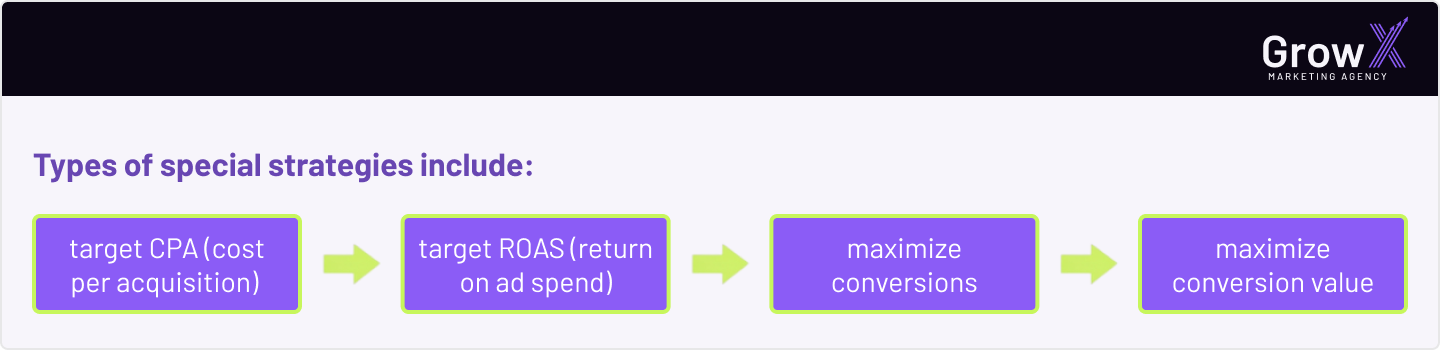
Each option focuses on different goals, from volume to profitability.
Google evaluates thousands of signals in real time. The system adjusts bids for your ads in each auction.
This dynamic process allows better positioning and scaling. But it requires:
Without these, machine learning cannot perform effectively.
Manual bidding remains a strong option for advertisers who want precision, control and predictability in their campaigns.
If you need tailored guidance for your strategy, you can submit a quote request.
You define the maximum CPC for keywords or ad groups. Google does not optimize bids in real time. Instead, your position depends on:
This process to help advertisers works best when control matters:
You can manually adjust bids based on device, location or audience. This improves efficiency but requires constant monitoring. Unlike automated types, manual strategies do not react instantly to user behavior.
The real decision depends on your data, goals and how much control you want over your Google Ads bidding. Each approach affects campaign performance differently, especially when it comes to scaling, cost efficiency, and stability.
Engagement with data defines success. If your account has enough conversions, smart bidding often improves return on ad spend. If not, manual bidding may outperform due to stability.
Smart strategy can lower cost per conversion by optimizing at auction level. Manual strategy may lead to higher costs but offers more predictable spend. The trade-off is between efficiency and control.

Enhanced CPC (ECPC) sits between manual and fully automated strategies. It allows you to keep manual control while still benefiting from some level of automation.
In this model, Google slightly adjusts your manual bids based on conversion likelihood. This makes ECPC a hybrid option for advertisers who want to gradually move toward automation without fully giving up control.
Compared to smart bidding, ECPC is less advanced in using machine learning but still improves efficiency over traditional manual bidding.
Selecting the right approach is a critical step in building effective paid digital ads. The strategy you choose should align with your goals, data quality, and how you plan to manage and scale your campaigns.
The wrong choice can lead to inefficient spending, while the right one helps improve performance and maximize results across your Google Ads strategy.
If your goal is profit, focus on return on ad spend. If it’s traffic, manual bidding may work better.
Smart bidding works best when your campaign has strong data and clear tracking in place. It is designed to scale performance using automation and machine learning.
You should consider smart bidding when:
In these conditions, automated special strategies can help optimize bids for your ads and improve overall campaign performance.
Automation is not always the right solution. Smart strategy can underperform if key conditions are missing or if the setup is unstable.
Avoid automated bidding if:
Each change in strategy resets the learning phase. This usually takes 5–7 days, during which performance may fluctuate. Frequent changes prevent the system from stabilizing and reduce the general effectiveness.
In such cases, manual control may provide more consistent results and allow you to better manage your bids for ads until enough data is collected for automation to work effectively.

Even the best Google Ads strategy requires proper implementation and testing. Choosing between smart and manual approaches is only the first step. Real results come from how you apply, analyze and refine your process over time.
Consistent testing helps you understand what actually improves campaign performance and allows you to scale with confidence instead of relying on assumptions.
Smart strategy uses machine learning to evaluate signals and automatically sets bids in each auction. This allows campaigns to react instantly to user behavior, device, intent and competition.
As a result, your ads can enter more relevant auctions and compete more effectively, especially in high-demand segments. This often leads to better reach and improved return on ad spend.
However, it is important to understand the learning phase. After launching or changing a strategy, the system needs time to stabilize.
Performance during this period may fluctuate, so results should be evaluated only after at least 14 days. Stable data is essential for accurate analysis and long-term optimization.
The most reliable way to choose between manual vs automated bidding is through structured testing. Instead of relying on theory, you should run controlled experiments and compare results.
A practical approach is to launch parallel campaigns with different strategies while keeping other variables consistent. This allows you to clearly measure impact.
Focus your analysis on key metrics such as overall campaign performance, cost per conversion and return on ad spend.
Start with manual bidding to collect data. Once you reach stable conversions, switch to smart strategy. This ensures smoother performance and better optimization.
You can review real examples in our digital marketing agency portfolio.

Manual bidding gives full control over bids. Smart bidding uses machine learning to automatically set bids based on real-time signals.
There is no universal answer. Manual works better for low data and control. Smart strategy is better for scaling with strong data.
This is the process of setting how much you are willing to pay for clicks or conversions. In Google Ads, your bid, quality score and competition determine ad position.