
How to choose business blog topics that can rank & drive traffic
Choosing the right blog topic isn’t about copying competitors - it’s about building authority that supports real business goals and drives traffic.
In this article, you’ll discover:
The debate around AI vs human writing is no longer theoretical. It affects budget allocation, brand positioning and long-term growth. Businesses now choose between AI-generated and human-generated content when planning website copywriting and blog strategy.
The debate around AI and human writing is often reduced to speed versus creativity. In reality, the divide is strategic. It is about how businesses build authority, shape perception and influence decisions. When content becomes a growth asset rather than a publishing task, the difference between automation and expertise becomes clear.
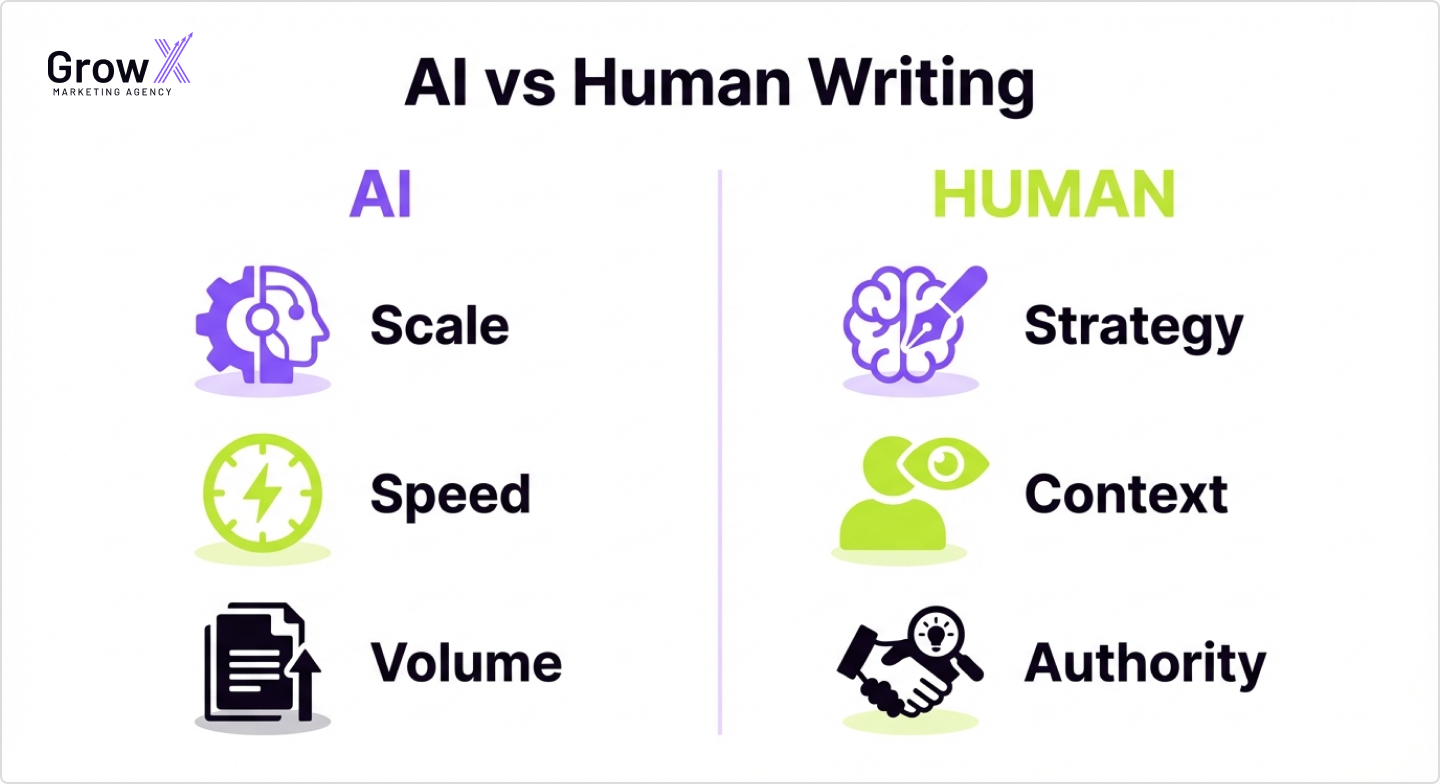
AI-generated content excels at volume. It can draft outlines, suggest headlines and structure articles in seconds. The use of AI reduces production time and supports scalability.
But strategy is different from output. A skilled copywriter understands positioning, audience psychology and conversion logic. Human writing brings context, nuance and lived experience into the message.
If your goal is fast indexing and surface-level coverage, AI wins on scale.
If you need authority, persuasion and content that feels emotionally intelligent, human-generated content performs better. Human writers bring a unique ability to express fear, urgency, trust and excitement because they have experienced those emotions themselves.
The differences between AI and humans are often framed as cost vs quality. That is simplistic.
The real divide is between automation and judgment. AI cannot evaluate whether you’re writing for positioning or for noise. It cannot fully understand long-term brand perception. That takes a human.
Publishing more content does not automatically create growth. Real impact comes from how content influences decisions, builds trust and supports revenue. The performance gap between AI-generated and human-generated content becomes visible when you measure authority, engagement quality and conversion behavior - not just traffic.
AI-generated content can attract impressions. But impressions are not revenue.
Trust drives conversion. Human-generated content increases perceived authority because it reflects insight, experience and critical thinking. Content quality becomes the real differentiator in saturated markets.
Ranking does not guarantee influence. Writing good SEO content requires more than keywords. It requires clarity, positioning and intent alignment. AI can assemble optimized phrases, but human writers bring strategic hierarchy and narrative cohesion. Influence happens when readers believe you.

Over-reliance on AI-generated content often leads to generic phrasing, weak optimization and awkward translation patterns.
Over time, this damages brand perception. Content that feels templated reduces authority signals and weakens differentiation. This is why brands investing in unique SEO content gain stronger long-term visibility.
AI tools offer speed and efficiency, but dependence on them creates strategic risk. When automation replaces editorial judgment, brands lose differentiation. Over time, this affects authority, trust and long-term search performance. Businesses must evaluate not only production cost, but also reputational impact.
AI tools learn from existing material. That means outputs often resemble what already exists.
Human-generated content introduces originality, strategic framing and bold positioning. Human writers bring perspectives that cannot be scraped from datasets.Without that, messaging becomes interchangeable.
Search engines increasingly evaluate credibility. Human content demonstrates experience and real-world context. A professional marketing team understands how to align expertise with search signals. AI alone cannot build true authority positioning.

The smartest strategy is structured collaboration between AI and human writers.
For example, AI can generate a first outline. I often use AI to test structure and see where emphasis shifts. Then I rewrite sections, deepen insights and refine positioning.
The real opportunity is not choosing between AI and humans - it is designing a system where both operate within clear roles. Competitive advantage emerges when automation increases efficiency while human expertise protects positioning, authority and brand perception.
AI supports research aggregation and draft frameworks. Humans refine tone, integrate brand voice and shape persuasive logic. Human writers bring a unique strategic filter that ensures alignment with business objectives.
Raw AI drafts are rarely final products. It takes a human to evaluate clarity, remove redundancy, enhance storytelling and ensure emotional resonance. AI-generated content becomes valuable only after strategic editing.
Choosing AI or human-only models creates risk. A short comparison illustrates this:

Sustainable website copywriting depends on systems, not tools. Leading blog marketing agency teams build structured workflows that combine automation with expertise.
The debate over AI vs human writing is no longer theoretical. Businesses must prepare for a landscape where speed is automated, but strategy, authority and trust remain human-driven. The future favors those who integrate both intelligently.
AI will not replace strong writers. It will replace weak processes. Writers who adapt will become strategists rather than producers. Human writers bring judgment, ethics and positioning - capabilities that AI cannot replicate fully.
The market is moving from production to content leadership. Brands must publish human-generated content that demonstrates authority, not just coverage. This requires editorial standards and alignment with broader digital marketing providers.
Businesses must invest in systems where AI accelerates drafting but humans control messaging.
Content that feels thoughtful, precise and emotionally intelligent wins long-term trust. In AI vs human writing debates, the answer is clear: AI supports execution, but humans drive growth for a brand or company.


Use both. AI supports structure and efficiency. A human writing ensures strategic depth, emotional intelligence and brand authority.
No. AI will redefine workflows. Businesses that combine automation with expert human judgment will outperform those relying on a single approach.