
Social media algorithms: understanding their impact on content visibility & reach
Social media algorithms determine what users see on their feeds. They are not myths - they are the systems that decide which content reaches the right audience.

Key Takeaways:
In crowded markets, this is a strategic asset. With fast, automated and often interchangeable content, a clear voice sets you apart.
Building this process isn’t about being clever - it’s about creating a voice that resonates, reflects your style and stays recognizable across all platforms. In the era of AI-generated content, consistency builds trust and long-term equity.
In crowded markets, this is a strategic asset. With fast, automated and often interchangeable content, a clear voice sets you apart.
Building this process isn’t about being clever - it’s about creating a voice that resonates, reflects your style and stays recognizable across all platforms. In the era of AI-generated content, consistency builds trust and long-term equity.
At its core, this process is the unique personality and communication style a company uses in every social media post, campaign and customer interaction. It shapes how your identity is perceived.
A clear voice ensures that every message supports recognition and positioning.
Brand voice → business impact framework
A strong voice shapes business performance. Clear identity boosts recognition, consistent messaging builds trust, and emotional clarity strengthens engagement. Strategic alignment links every message to long-term goals, supporting company equity.
Isn’t a slogan or campaign theme - it’s a strategic foundation guiding every content decision.
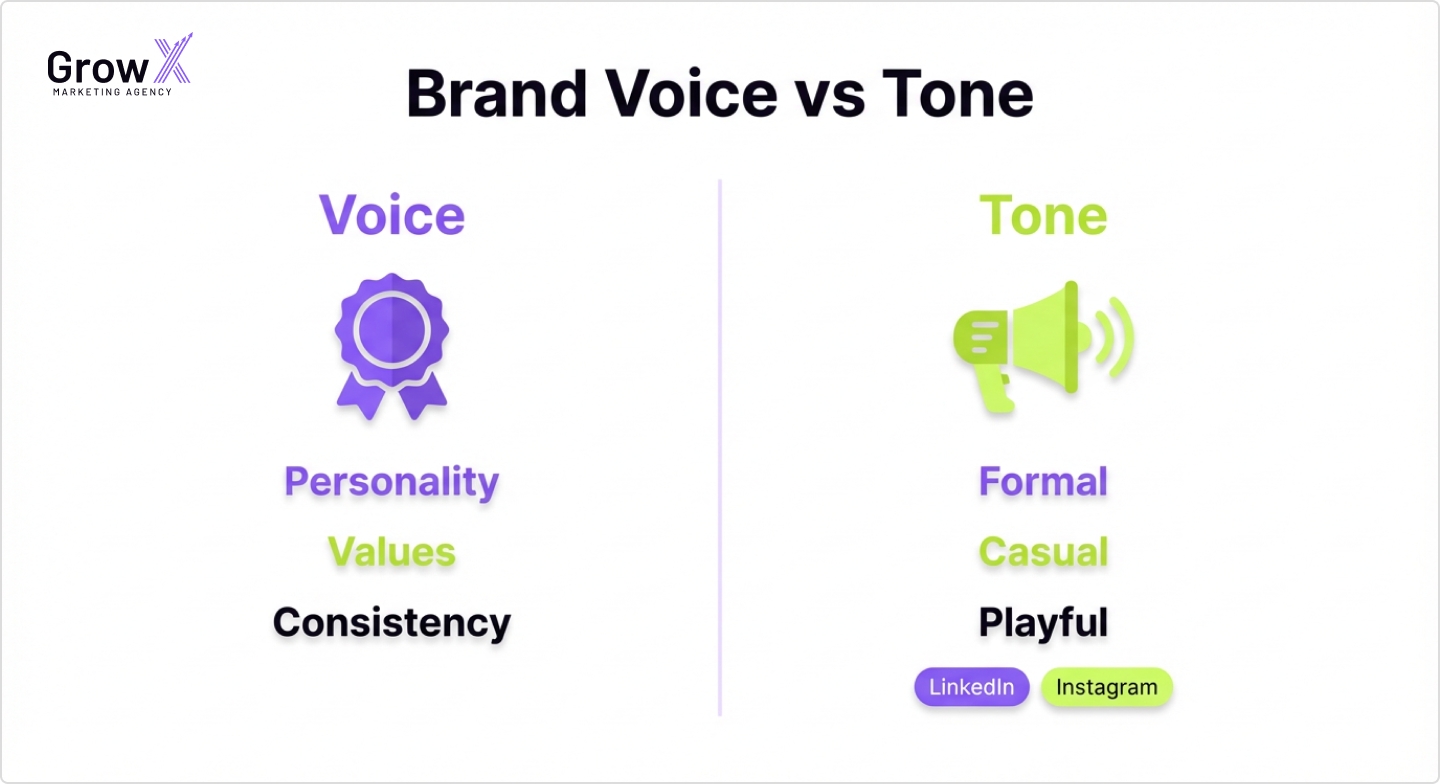
Voice is stable - tone is flexible. Tone may shift by context, audience, or platform, but the core personality stays intact.
Think of your brand as a character with fixed traits that speak differently in a boardroom than at an event. On LinkedIn, it may sound authoritative: “We are experts you can trust.” On Instagram, it may be energetic: “We know what works and we’re excited to show you.”
Consistency signals reliability. When audiences repeatedly hear the same structured, confident and aligned messaging, they build mental shortcuts.
Over time, a recognizable voice that resonates becomes part of memory. This is how many companies move from awareness to preference.
In oversaturated industries, recognition often matters more than reach. A consistent voice on social media strengthens recall even when algorithms fluctuate.
Consistency across platforms boosts growth, improves recall, and reduces confusion.
If posts sound different, audiences struggle to connect identity to message, slowing growth. A unified approach also makes content operations efficient. Companies that invest in professional management of social media create structured workflows that protect consistency while scaling production.
Strong brands don’t improvise. They define voice strategically, starting with positioning.
The key is authenticity - imagine your brand as a person with clear traits that guide communication. Tone can adapt by context, but the core personality stays stable. Leading brands align mood with business, audience and culture to ensure it truly reflects.
Start with business analysis. Examine your mission, values, target audience, clients, partners and even employees.
Your voice should reflect your brand beyond social media. It must align with operations, culture and positioning.
For example, at our Grow X, the persona is structured, system-driven and optimistic. Structure creates control. Positivity fuels momentum. In strong moments, this drives higher results. In difficult moments, it prevents stagnation.
Values alone are abstract. Strong principles translate values into communication rules.
Example structure:
These principles allow teams to keep you consistent even as content volume increases.
Each platform has norms. LinkedIn rewards authority. Instagram values relatability. TikTok favors speed and creativity.
However, adaptation should not dilute identity.
A strong voice that resonates remains stable in personality while adjusting tone. The goal is alignment, not uniformity.
Consistency needs structured processes, clear guidelines and shared strong principles. This ensures every post reflects the brand and lets teams scale content without diluting its recognizable personality.
Consistency cannot depend on one person reviewing every post.
It requires special documentation:
Tools can aid execution but should not define strategy. AI may speed production, but it doesn’t preserve voice and often produces generic content.
Tools should follow your principles, with human oversight to maintain authenticity. Experienced digital marketing providers know how to balance automation and strategic identity.
Adaptation fits each platform’s culture without losing your brand’s essence. Fragmentation occurs when the voice becomes inconsistent or generic, weakening recognition.
If a post could belong to any competitor, the voice is too diluted. Each message should reflect your brand through structure, vocabulary, rhythm and perspective, keeping identity clear across all platforms.

Many brands assume they have a right mood because they produce “good content,” but visuals or clever copy don’t ensure consistency.
Without a defined personality, posts can vary, confusing audiences and weakening trust. A true voice requires clear definition, documentation and consistent use across all posts and workflows.
Content can be visually attractive yet strategically empty. Without a defined voice, posts may generate engagement but fail to build recognition. Short-term performance does not equal long-term positioning.

Inconsistency rarely comes from creativity gaps. It comes from unclear positioning.
Companies often blame platform changes or team size. In reality, they never formally define a voice.
When identity is vague, every contributor interprets it differently.
Imitating competitors creates short visibility but long confusion. True differentiation begins with internal clarity, not external comparison.
Review our digital marketing agency portfolio to see how distinctive positioning translates into recognizable communication systems.
A brand voice must stay consistent but not static. Markets, culture, and audience expectations change.
Regular evaluation ensures your mood still reflects core personality, values, and goals. Thoughtful adaptation - adjusting tone or references without altering identity - keeps your company recognizable and relevant across all platforms.
Engagement metrics alone are insufficient.
Ask:
Recognition is a stronger metric than likes.
Data informs optimization. It should not redefine personality. If performance fluctuates, adjust format or distribution before altering core mood.
Brand voice is the unique long-term asset. It should not be rebuilt around short-term trends.
Cultural awareness matters. However, trend chasing often damages authority. Evolve vocabulary and references carefully. Maintain strategic clarity. Strong brands adapt context while protecting identity across all platforms.


Create documented guidelines, define clear principles and align all contributors. Use tools to support execution, but rely on structured systems. Regularly review content to ensure it continues to reflect your brand.
Brand voice is the stable personality of your company. Tone is how that personality adjusts to different contexts. The voice remains constant. Tone adapts.