Google Ads account structure: best practices & complete guide
A properly built Google Ads account is the foundation of profitable paid traffic. Many businesses focus on ads and bids, but ignore structure.
Many businesses assume getting paid advertising pricing is simple, but agency costs, management structure and ad budgets can change total spending significantly.
The truth is that advertising with Google cost depends not only on clicks, but also on strategy, optimization and the pricing model for your business. If you want to better understand how internet ads work, explore this guide about what is paid media marketing.
What you’ll learn from this article:
Google Ads management in 2026 is rarely just about launching a few campaigns. In most cases, it covers strategy, setup, ongoing optimization, tracking, reporting and constant performance adjustments.
The final cost usually depends on how complex the account is, how much ad spend is involved and how hands-on the management needs to be.
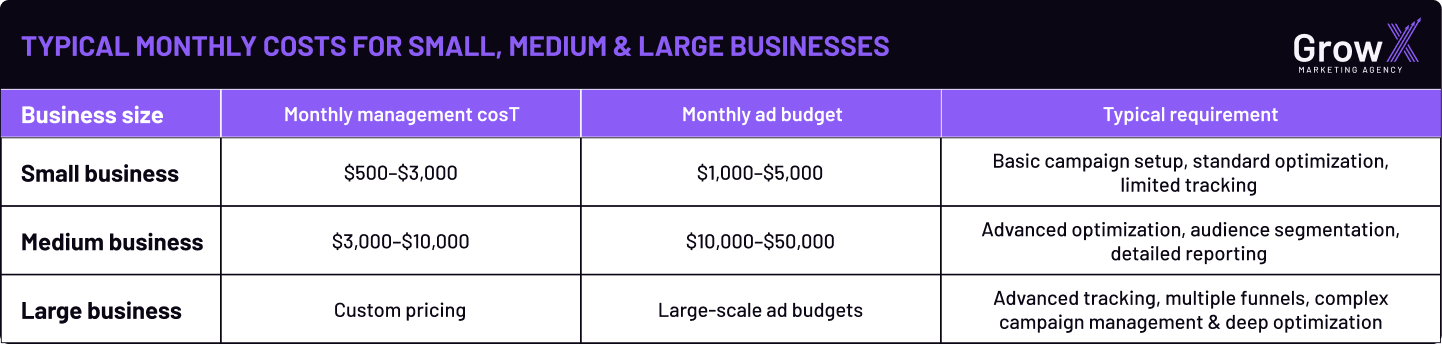
Most agencies either charge a percentage of your ad spend or work with a fixed monthly retainer. For smaller businesses, management fees often range from $500 to $3000 per month.
For larger accounts with multiple campaigns, advanced tracking and more complex advertising structures, agency costs can grow significantly higher.
With this model, the agency fee grows together with your advertising budget. For example, if you spend $10,000 per month on ads and the management fee is 15%, you’ll pay $1,500 for management.
The biggest advantage here is flexibility - the pricing scales as your campaigns grow. But there’s also a downside: agencies naturally earn more when ad spend increases, even if performance doesn’t improve at the same pace.
There is no single right pricing model. Each structure works differently depending on business goals, growth stage and campaign complexity. The right pricing model for your business depends on budget size, expected involvement and long-term objectives.
Fixed pricing gives predictable monthly costs. You pay for team resources and expertise regardless of results or budget changes. This model works well for stable accounts with predictable workloads. However, as campaigns grow, attention can become diluted.
This is one of the most common models in paid advertising. As spending increases, management fees increase too. It is simple and scalable, but businesses should understand that higher spend does not always mean better performance.
Performance-based pricing sounds attractive because agencies get paid only for leads or sales.
However, the risk is that optimization may focus on cheap conversions instead of real business quality. Low-value leads can inflate numbers without improving revenue.

Professional management is more than simply running ads. It includes continuous strategic work focused on performance, optimization and long-term growth.
Most Google ads management in 2026 services include campaign setup, keyword research, audience targeting, bid adjustments, conversion tracking, reporting and ongoing optimization. Agencies also monitor performance signals, test creatives and improve account structure over time.
In many cases, management fees also cover strategic recommendations, landing page feedback and performance analysis to help businesses improve results from paid advertising, not just spend more on advertising with Google cost.
This usually includes:
Good management helps improve your search engine visibility and advertising efficiency together.
Tracking is one of the most important parts of internet advertising. Without proper conversion tracking, campaigns optimize blindly. Clean reporting helps businesses understand real cost per acquisition and ROI.
Strong ad messaging improves CTR, conversion rates and Quality Score. Agencies also test creatives, optimize landing pages and refine targeting strategies over time.
If you want professional support, you can buy ads Google, a structured campaign strategy.
Pricing usually depends on campaign complexity, tracking setup, reporting requirements and ad budget size. Accounts with larger ad budgets often require deeper optimization, more testing and permanent monitoring.
Agency expertise also affects pricing. Experienced teams usually charge more because they provide strategic optimization, cleaner data analysis and stronger performance control. In many cases, lower agency costs may also mean limited support, slower optimization or overreliance on automated tools instead of real strategy.
As ad budgets grow, campaign management becomes more complex. Larger accounts usually require more optimization, deeper testing, detailed reporting and stronger strategic control.
More campaigns, keywords and audience segments also increase the amount of daily management work. Because of this, higher spending accounts typically involve higher agency costs and more ongoing optimization effort.

Experienced specialists often charge more because they reduce mistakes and improve efficiency faster. In competitive industries, real expertise can save far more money than a cheaper but inexperienced provider.
The more complex the account, the more time goes into research, structure, testing and ongoing optimization. You’re not just running ads - you’re managing multiple layers of targeting, performance tracking and continuous adjustments to improve results.
There’s no universal setup that fits everyone. The right pricing model depends on your business stage, goals and how much internal support you already have.
If you’re focused on stability and predictability, a fixed model is often easier to manage. If you’re scaling aggressively or running multiple campaigns, a more flexible structure usually makes more sense because it adapts to workload and growth pace.
For small businesses, fixed pricing is often the most comfortable option because it keeps costs predictable and easy to plan.
As a business grows and campaigns become more advanced, many shift toward performance- or percentage-based models. At that stage, advertising becomes less about setup and more about continuous scaling, optimization and testing across multiple segments.
A flat fee model makes more sense when your advertising setup is stable and doesn’t change too often. It gives you clear monthly costs, which makes planning easier and removes uncertainty around budgeting.
This approach usually works best when the account is moderately complex and doesn’t require constant scaling or restructuring. It’s a good fit for businesses that value predictability over variable spending.
Percentage-based pricing, on the other hand, tends to fit faster-growing campaigns where ad spend and activity levels change frequently and management effort scales alongside performance.
Before hiring, ask:
Transparent communication is critical in paid advertising partnerships.
If you want pricing tailored to your goals, you can always get a free price quote.


It depends on your industry and competition. In some niches, $10 daily can generate useful data. In competitive markets, it may be too limited for effective optimization.
Most agencies charge either:
The final cost depends on campaign complexity, advertising goals and management scope.