SEO Metrics That Actually Matter (and What Most Reports Completely Miss)
Most SEO reports look impressive but don’t help leaders make decisions. They list rankings, sessions and charts without explaining what actually drives revenue.
Modern SEO is no longer about keywords alone. To achieve stable rankings and real authority, information must prove its value, reliability and expertise. This is where EEAT SEO becomes essential. It defines why some pages stay at the top while others struggle to gain visibility.
Understanding how E-E-A-T works in practice allows you to create good SEO content that not only ranks but also builds trust and drives decisions.
Key takeaways:
To apply E-E-A-T effectively, you need to see it not as theory, but as a practical framework for evaluating quality. It shapes how search engines and users perceive your content.
Today, Google uses to evaluate pages not just by relevance, but by credibility and depth. That’s why understanding E-E-A-T is key to improving visibility and long-term performance in search.
If you ask what is EEAT, the simplest answer is this: it’s a framework Google uses to evaluate quality. It stands for expertise, authority, trust and experience. These signals help determine whether content is reliable and deserves visibility in search results.
Good SEO content today is not just optimized text. It must show real knowledge, practical insights and trustworthiness.
Originally, Google focused on E-A-T. Later, it added Experience as a new component in this system. This changed how content is evaluated.
Now, E-E-A-T for topics that require real expertise depends heavily on first-hand experience. Content without real examples often looks generic and performs poorly.
E-E-A-T isn’t a direct ranking factor. It is a model used to assess quality.
However, Google uses it to evaluate pages through multiple signals. These include depth, author credibility and user engagement.
In practice, Google uses E-E-A-T as part of a broader system, using a mix of factors to determine rankings.

Google doesn’t rely on a single signal to rank content. Instead, it evaluates pages through a system that combines algorithms and human-defined standards. E-E-A-T plays a key role in this process by helping determine whether content is credible, useful and trustworthy enough to rank.
Google’s search quality rater guidelines define how human evaluators review content. They assess reliability, expertise and transparency.
Raters do not influence rankings directly. But their feedback helps improve how algorithms understand special quality.
Algorithms scale what raters define. They detect patterns that signal trustworthiness and expertise.
This means for these topics that could impact users significantly - like finance or health - must be especially strong. Weak signals reduce visibility, even if keywords are well optimized.
Understanding E-E-A-T is not enough. The real impact comes from how you apply it in practice. Content must clearly show experience, credibility and real value, not just claim it.
When E-E-A-T is implemented correctly, it improves both user trust and search performance, turning content into a reliable asset that supports rankings and business goals.
The strongest signal is real experience. Content that includes case studies, results and tested processes performs better.
A general guide can rank, but a post with data and examples shows real expertise and authority trust. This is what separates average content from high-performing assets.
Transparency is critical for EEAT optimization. Users and search engines need to understand:
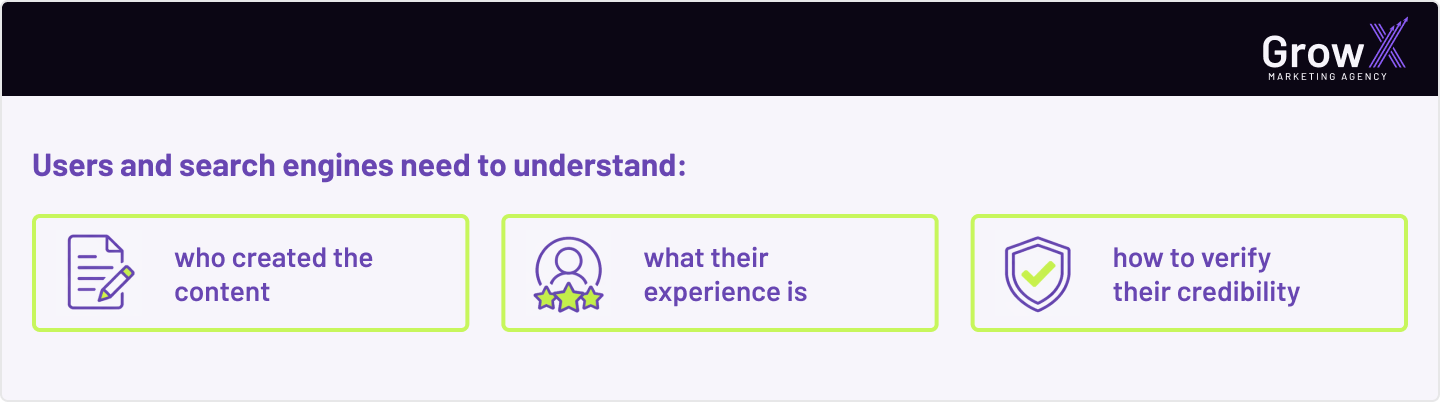
Clear author pages, company details and contact options increase trustworthiness and improve perception.
For example, strong brands often support content with proof and case studies, like those shared in a professional SEO experts blog.
Content should answer one key question: can users trust it enough to act?
This means avoiding generic rewriting. Instead, focus on insights, real scenarios and clear conclusions. Strong quality always reflects real-world application.
E-E-A-T is not only about what you say, but how your content is presented and structured on the page. On-page SEO plays a key role in reinforcing credibility, making expertise visible and helping both users and search engines trust your content.
By aligning structure, authorship and transparency with E-E-A-T principles, you strengthen signals that directly impact visibility and long-term performance.
Author bios are not decorative. They signal expertise. Include real achievements, roles and relevant experience.
Adding links to professional profiles strengthens credibility and supports EEAT SEO signals.
Reliable references credible sources. This improves reliability and shows that claims are backed by data.
Avoid unsupported statements. Instead, confirm facts and show where insights come from. This is a key part of EEAT optimization.
All elements must work together. Experience, expertise, authority and trust should be visible across the page.
When done correctly, this improves online visibility and creates content that performs consistently in search.

E-E-A-T is not a static concept. It evolves with search behavior, technology and user expectations. To stay competitive, businesses must apply E-E-A-T principles across their entire strategy, not just individual pages.
When integrated correctly, it helps create scalable systems that build trust, improve rankings and support long-term growth in modern SEO environments.
AI content is everywhere now, but E-E-A-T isn’t about how content is created. It’s about whether people can actually trust it.
If AI text is published “as is,” without real examples, experience or validation, it usually feels generic and unreliable. To make it work, you need to refine it - add insights, real cases and expert input.
In practice, AI can speed things up, but trust still comes from human experience and proof.
Strong content includes:
This is the foundation of effective content marketing solutions that drive long-term results.
You can see the impact of E-E-A-T in how your content performs - through engagement, rankings and conversions.
Pay attention to how users interact with your pages. If something underperforms, it’s often a signal to add more depth, clearer explanations or real proof.
In practice, improving results usually comes down to one thing: making your content more trustworthy and grounded in real expertise.
If you need marketing advice, focus on strengthening trust signals and aligning content with real expertise.


A strong example is an article with real case studies, data and clear author credentials. It shows experience, supports claims and builds trust.
Yes. It remains essential for special quality and directly affects how information performs in competitive search results.
It is a framework Google uses to evaluate trust, expertise and experience. It helps determine which information deserves visibility and user trust.