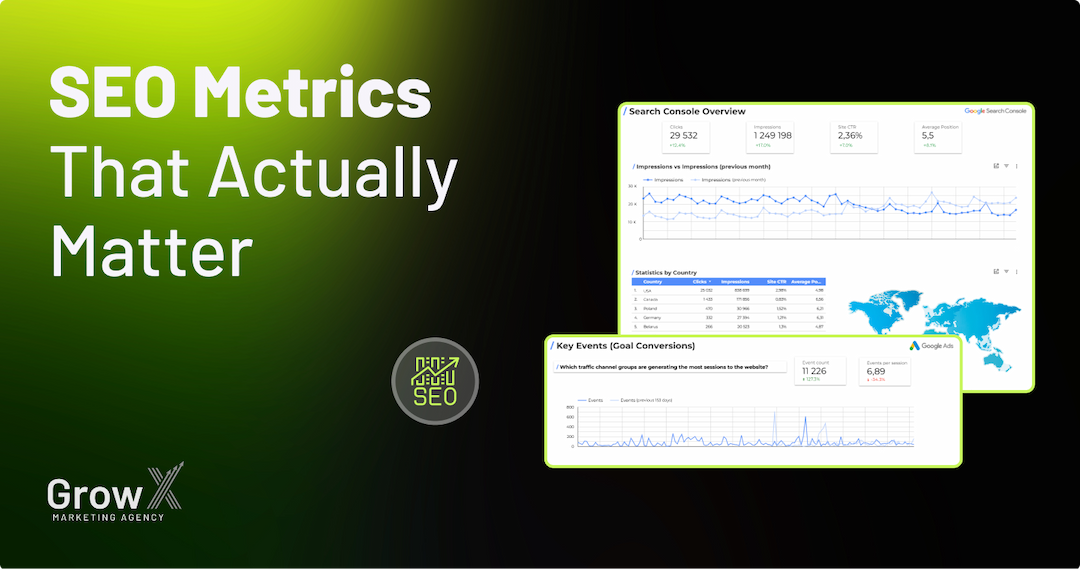
SEO Metrics That Actually Matter (and What Most Reports Completely Miss)
Most SEO reports look impressive but don’t help leaders make decisions. They list rankings, sessions and charts without explaining what actually drives revenue.
Key takeaways:
Search intent is one of the most important ranking factors in modern SEO. If your content doesn’t match the user goal, it won’t perform - no matter how strong your backlinks or technical setup are.
To increase ranking, you must understand what users are looking for and why they search. Understanding users allows you to create content that matches expectations and improves SEO performance.
When content matches the user goal, search engines prioritize it higher. When it doesn’t, metrics drop: bounce rate rises, CTR declines and rankings fall. Working with an experienced marketing company ensures your strategy aligns content with user goals effectively.
Search intent sits at the core of modern SEO because rankings depend on relevance, not just keywords. Understanding users helps you create pages that truly match what users are looking for. When content aligns with expectations, it improves SEO performance and increases ranking sustainably.
Search engines evaluate whether your page matches the user goal. They analyze behavior signals such as dwell time, click patterns and pogo-sticking.
If users are looking for a guide and land on a product page, they leave. This tells special engines your page does not match the user's goal. Over time, rankings decline.
When SEO isn’t optimizing for search goals, traffic may increase but conversions stay low.
People search with specific expectations. If the content structure does not satisfy those expectations, engagement drops.
Content-intent mismatch affects:
Modern SEO is no longer keyword stuffing. It is intent alignment. Professional SEO strategies focus on classification first, then keyword mapping. If you need structured support, explore professional SEO services.
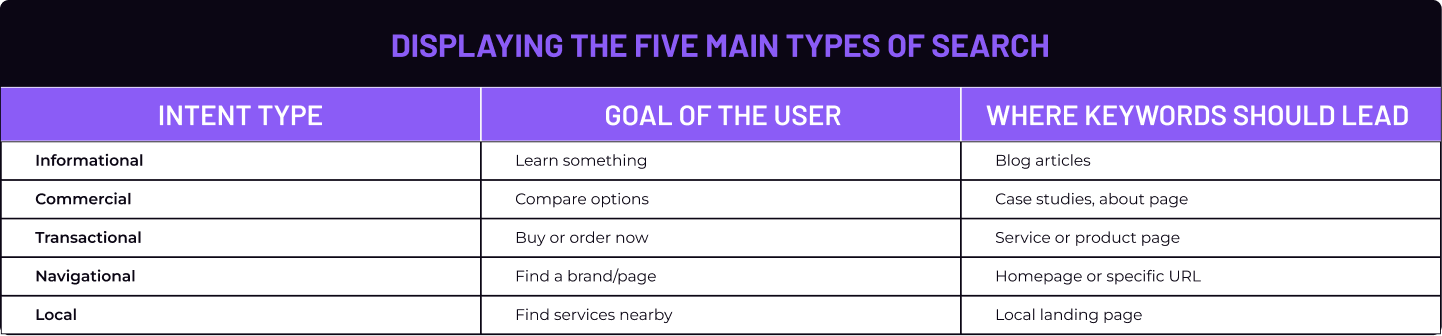
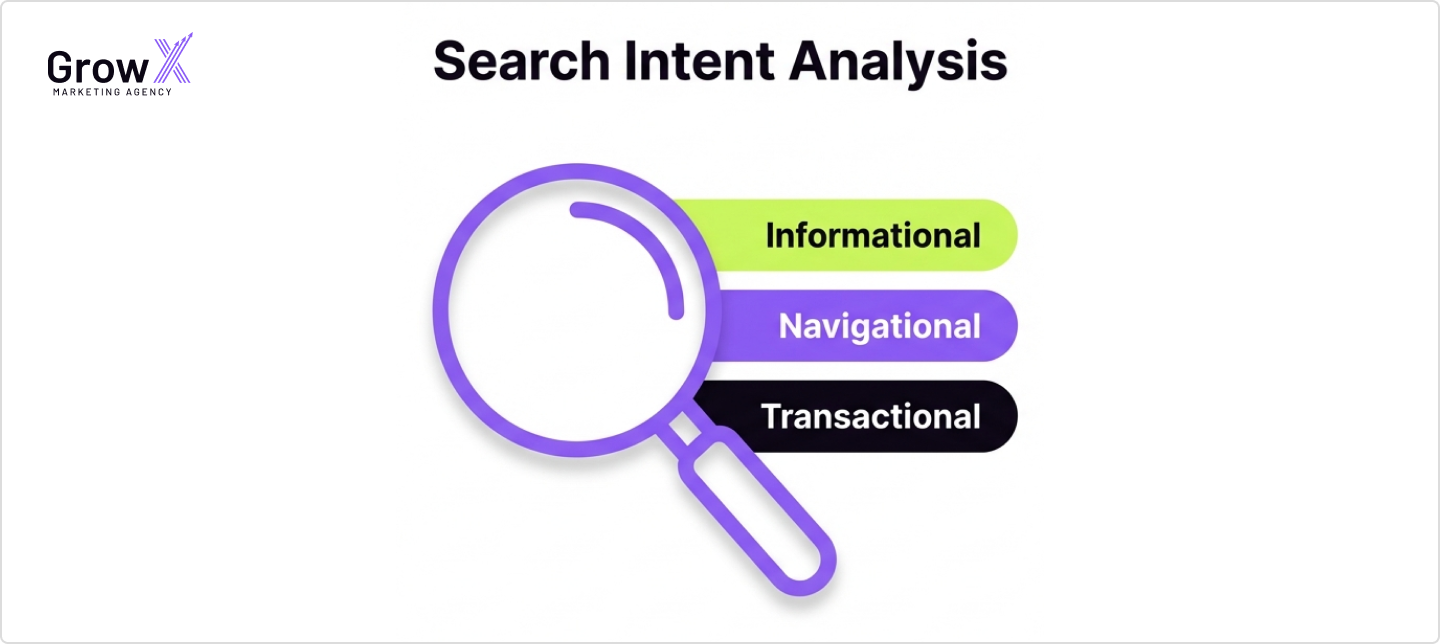
Informational intent means the user wants knowledge. These keywords should lead to blog content. Search engines prioritize content that explains clearly and comprehensively.
Commercial intent indicates the user is considering options. They compare solutions. Pages with reviews, comparisons and case studies rank best.
Transactional intent shows strong purchase readiness. These pages must be optimized for conversion and clarity.
Navigational intent helps users reach a specific brand or page. Strong brand signals support rankings here.
Local intent connects services to geographic areas. Location pages and local SEO signals are critical.
In OKR tracking, we measure what percentage of keywords rank in the top positions.
Each page must target not only unique keywords but also the correct goal. Informational keywords go to blog posts. Commercial investigation queries go to case pages. Transactional intent keywords must lead to service pages.
This structure increases ranking by matching page purpose with goal type.

Correctly identifying search behind keywords is the turning point between average and high-performing SEO. Many pages fail not because of weak optimization, but because they target the wrong goal type. Understanding the user ensures each keyword leads to the right page and supports stronger visibility.
Competitor analysis reveals how the market interprets intent.
In our workflow, we use SE Ranking to analyze what percentage of search intent competitors use across their pages. This helps classify keywords correctly and identify gaps.
If most top-ranking pages for a query are guides, the goal is informational. If they are service pages, the goal is transactional.
SE Ranking helps us analyze keyword clusters and evaluate how search engines structure results for different queries. By reviewing SERP layouts we can better understand how a goal is interpreted for each keyword group.
We also use clustering to ensure that keywords with similar intent are grouped correctly and mapped to the right pages. This helps avoid cannibalization and keeps the site structure aligned with user expectations.
Monitoring ranking dynamics and competitor pages allows us to see how search behavior evolves over time and adjust content strategy accordingly - before performance declines.

Monthly reporting in Looker Studio shows impressions, clicks, CTR and average position.
This data reveals what users are looking for and where they click. It also shows how Google interprets goals.
Understanding users is not a one-time task. It requires continuous evaluation.
Aligning content is one of the fastest ways to increase special ranking sustainably. Even strong technical SEO cannot compensate for goal mismatch. When your pages consistently match what users are looking for, search engines prioritize content more confidently.
When content matches the user's goal, behavioral signals improve. Users stay longer, engage more and convert at higher rates.
This sends positive signals to search engines that your page satisfies the query. As a result, visibility improves SEO performance and strengthens ranking stability over time.
Pages built specifically as content for search outperform generic content because they directly respond to the user wants behind the query.
Search engines prioritize content that fully answers the query within its intent category.
If the user wants a comparison, a generic blog post will not rank. If they want to buy, an informational guide will underperform.
Special engines evaluate structure, format, headings and page type to determine alignment.
If SEO ignores search goals, rankings stagnate. Traffic becomes unstable. Conversions decline.
You may rank temporarily, but long-term performance drops because engagement signals do not confirm relevance.
A strong marketing company understands that intent mapping is the core of scalable SEO. Learn more about strategic digital marketing services.

Even when you understand the basics of the search goal, many SEO strategies fail in execution. Advanced considerations are essential to avoid long-term ranking and performance issues. Ignoring these can lead to wasted traffic, low conversions and misaligned content strategy.
Misclassifying transactional intent as informational drives traffic that does not convert. Over time, this lowers ROI, distorts performance metrics and undermines the effectiveness of your SEO efforts. Accurate mapping is critical for sustainable rankings and revenue growth.
User goals can shift seasonally. For example, commercial queries may turn transactional during peak sales periods. Continuous monitoring by a professional marketing team ensures strategy adapts accordingly.

Keywords alone are not enough. Context matters. People search with specific motivations. Optimizing for a search goal means understanding the problem behind the query, not just the phrase itself.

This is the reason behind the query. It explains why the user searches and what outcome they expect. It can be an informational, commercial, transactional, navigational or local goal.
Yes. User behavior evolves due to trends, seasonality and market changes. That is why understanding user goals requires ongoing analysis, not a one-time audit.