SEO Metrics That Actually Matter (and What Most Reports Completely Miss)
Most SEO reports look impressive but don’t help leaders make decisions. They list rankings, sessions and charts without explaining what actually drives revenue.
In this article, you will learn how to:
Ecommerce SEO is the process of building scalable organic growth across hundreds or thousands of pages. In contrast, traditional SEO usually supports a limited site structure and focuses on lead generation.
When we talk about this topic, we mean a system where structure, intent mapping, and revenue distribution matter more than single-page rankings. On a corporate site, one service page may drive most leads. In a website, revenue is distributed across many categories and products.
This is why ecommerce focuses on architecture first. Without clear category logic and intent separation, pages compete against each other. Strong strategies prevent cannibalization and ensure every page has a defined role in growth marketing agency too.
At first glance, general principles seem universal. However, the strategic logic behind ecommerce and traditional websites differs significantly. The scale of pages, revenue structure, and intent distribution reshape how optimization is planned and executed. In traditional websites, SEO often acts as a targeted acquisition channel.
For examples of how these strategies translate into results, explore our digital marketing agency portfolio.
In online retail, SEO supports revenue directly. That means conversion rate and transactional performance matter as much as rankings.
Special techniques are built around product visibility, category scalability, and internal linking logic. Teams must continuously optimize product pages using structured data, clear hierarchy and search-driven filters.
Unlike standard sites, where traffic alone may define success, ecommerce SEO in the USA must connect keyword targeting to sales outcomes.
Traditional websites usually have simpler architecture. Fewer pages mean fewer structural risks.
The strategy often centers on informational guides, local visibility, and service positioning. The goal is visibility and lead capture rather than managing thousands of indexed URLs.
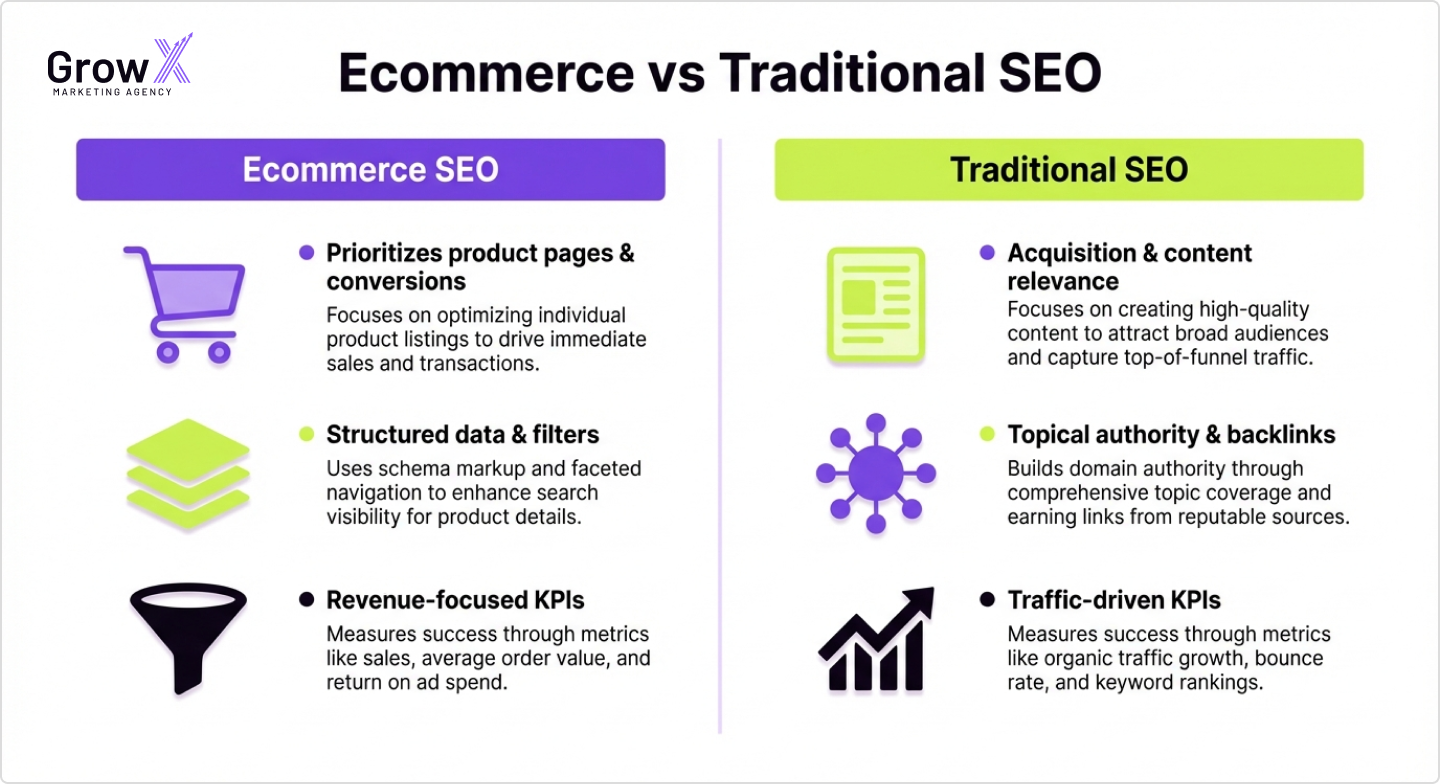
In ecommerce, SEO decisions impact turnover. A mistake in intent classification can reduce revenue, not just traffic.
For service websites, SEO is a channel. For ecommerce, it becomes infrastructure. Experienced teams align SEO with product margins, seasonality, and scaling strategy.
Keyword strategy defines how traffic converts into business results. While both ecommerce and traditional websites rely on search data, the structure and intent distribution behind keywords differ significantly. In ecommerce, keyword mapping must reflect category hierarchy, product depth and purchase intent. On regular websites, it often centers on topical authority and lead acquisition.
Intent mapping is critical in both models, but scale changes everything.
Category pages target broad transactional phrases, while products target precise long-tail keywords. These highly specific terms often convert better because they match buying intent.
On traditional sites, keyword research often emphasizes informational or branded queries.
Transactional queries drive sales. Informational queries build awareness.
In the ecommerce topic, both matter, but distribution must be accurate. Category pages rank for high-volume relevant keywords, while product pages capture intent-driven searches.
Traditional sites often rely more on content hubs and articles to expand topical authority.

Category pages in an ecommerce website must balance content and usability.
They require clear headings, crawlable filters and structured internal links. The right optimization of categories improves visibility without creating duplicate indexing issues.
Technical complexity is where ecommerce and traditional SEO diverge the most. An online store can contain hundreds or thousands of URLs generated by categories, filters, variations and pagination. Without strict technical control, indexing becomes chaotic and rankings unstable. In ecommerce, technical SEO does not support work - it is the foundation of scalability.
Large stores generate duplicates through filters, pagination, and sorting.
Proper canonicalization and crawl control are essential in technical ecommerce SEO. Without it, search engines waste crawl budgets and rankings decline.
Traditional websites face fewer duplication risks due to smaller structures.
Speed impacts both rankings and conversion rate.
Online stores must manage image weight, scripts, and server response times. Every second affects revenue. Technical performance is part of special strategies, not just UX improvement.
Structured data for products, reviews, and pricing enhances click-through rates. Schema markup and internal linking systems help a website compete in crowded SERPs. Insights from proven sources often show that structured architecture drives measurable growth.

Once the foundation is built, this growth depends on precision and scalability. Advanced strategies go beyond basic optimization and focus on revenue impact, authority distribution, and performance analytics. In competitive markets, incremental improvements across categories and products compound into measurable turnover growth.
SEO must align with the purchase funnel. Ecommerce techniques integrate CRO testing, internal linking experiments, and search-driven merchandising. The goal is not only ranking, but revenue expansion.
Authority matters in both models. However, special requires deeper category-level authority, not only homepage strength. Contextual links to collections improve performance across multiple transactional clusters.

Tracking performance across thousands of URLs requires structured dashboards. Segmentation by category, intent, and margin helps refine optimization priorities. Educational insights from a blog marketing agency can support ongoing learning and testing.
Ecommerce operates under a different growth logic than traditional websites. The number of pages, the distribution of revenue and the complexity of user intent demand a structured and scalable model. In this environment, small architectural mistakes can limit growth across hundreds of URLs. That is why this optimization requires deeper strategic control and continuous analysis.
Unlike traditional SEO, it relies on a scalable internal structure. Each category supports the next level and internal linking distributes authority strategically rather than randomly.
Proper hierarchy, canonicalization and link planning ensure pages rank without cannibalizing each other. This structure helps search engines index content efficiently and improves visibility across all product and category pages.
For service sites, SEO drives leads from a few key pages. This requires precise intent mapping, structured internal linking and ongoing technical monitoring. Optimizing each page for relevant keywords, user intent and conversions ensures SEO contributes directly to business growth rather than just traffic.
Traditional SEO often relies on a limited number of high-performing pages.
In ecommerce, revenue is distributed across many URLs. Proper use of long-tail keywords, structured hierarchy, and technical governance ensures sustainable growth.
Ultimately, SEO e-commerce is not just about rankings. It is about building an organic sales engine that scales with inventory and demand.


Yes. Organic traffic compounds over time and reduces reliance on paid ads. For online stores, SEO builds predictable revenue streams and improves long-term profitability.
It increases visibility for products and categories at every stage of the buying journey. Without it, even the best-designed store struggles to attract qualified traffic and sustain growth.