Social media algorithms: understanding their impact on content visibility & reach
Social media algorithms determine what users see on their feeds. They are not myths - they are the systems that decide which content reaches the right audience.
Brand growth depends on balancing ads on social media, organic ads and strategic social media marketing. Rather than choosing paid vs organic, businesses should understand how each supports long-term growth, visibility and sustainable growth.
While ads on social deliver fast reach, organic and paid social media serve different purposes. The most effective social media campaigns combine both to help your business build awareness, trust and scalable performance.
Key insights about this article:
Both social media and advertising contribute to brand growth, but they do so in different ways. Organic efforts help build trust, engagement and long-term audience relationships, while special campaigns provide faster visibility and scalable reach. The strongest brands typically combine both approaches through a structured smm digital marketing strategy that balances sustainable growth with immediate performance.
Organic social media marketing relies on platform algorithms, where visibility is earned through relevance, engagement and consistency.
Successful strategies use user-generated content, storytelling and educational content to build trust over time. Although results come more slowly than with a paid ad, organic efforts create stronger engagement and lasting brand loyalty.
In contrast, targeted advertising delivers immediate reach. Distribution ensures visibility even when organic reach is limited by platform algorithm changes.
Paid digital ads allow brands to scale quickly, test messaging and reach highly specific audiences. Unlike organic efforts, ads on social media provide predictable exposure but depend on continuous investment.
Special strategies support credibility and brand loyalty, while paid channels accelerate acquisition. Together, they create a balanced ecosystem where social media marketing 3-6 activities reinforce both visibility and trust.
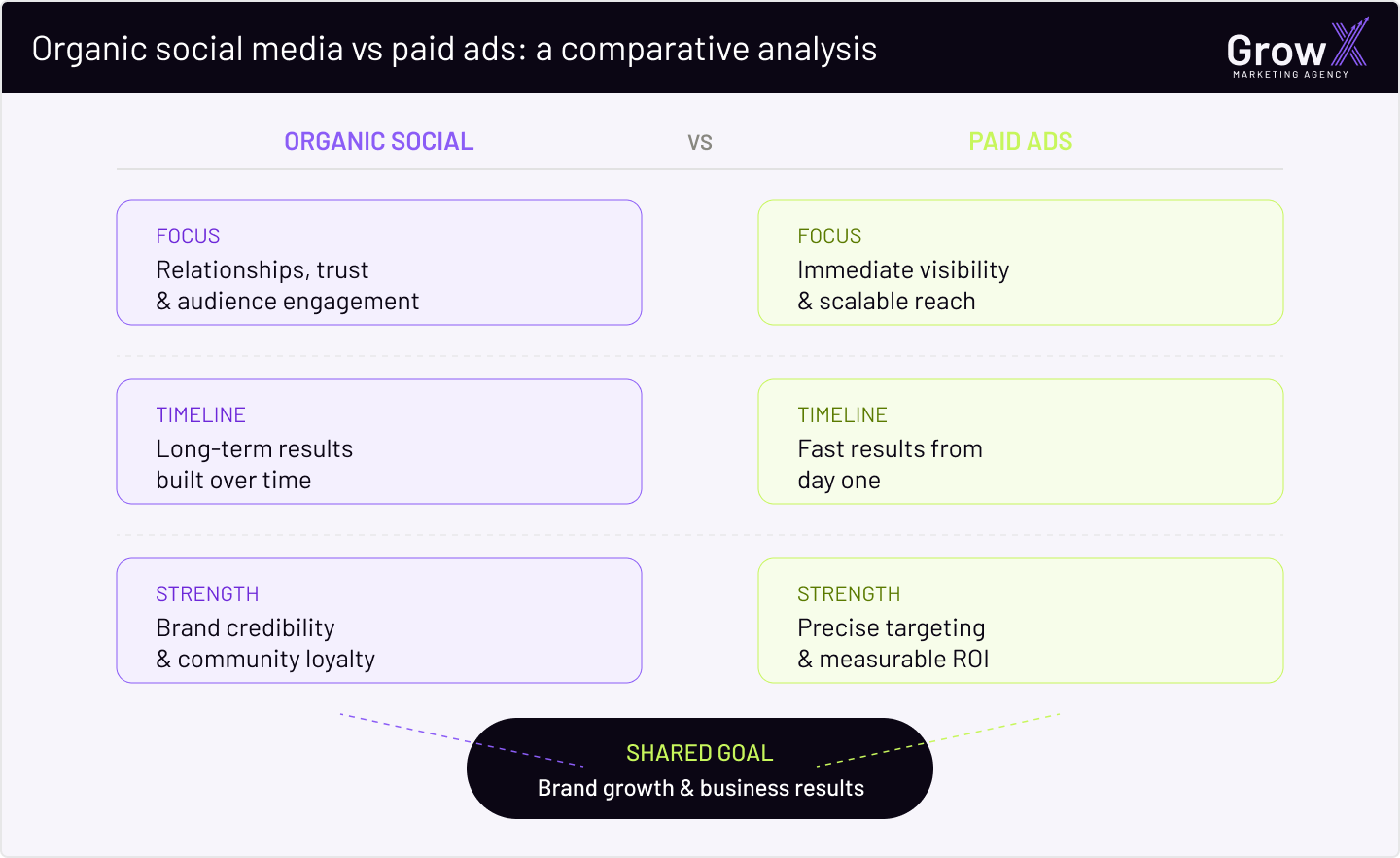
Although both channels can support brand growth, they operate differently and produce results on different timelines. Organic social media focuses on building relationships, trust and audience engagement over time, while paid advertising prioritizes immediate visibility and scalable reach. Understanding the strengths and limitations of each approach helps businesses allocate resources more effectively and create a strategy that balances short-term performance with long-term brand development.
Nature content builds reach slowly through engagement signals, while ads on social platforms provide instant visibility. Special campaigns scale faster, but organic reach compounds over time.
Users often trust content more because it feels authentic. User-generated content and consistent posting strengthen credibility more than a paid ad, which may be perceived as promotional.
Paid channels deliver immediate traffic, while organic social media marketing supports long-term growth. The most stable systems combine both to maintain consistent visibility and engagement.
Likes, comments and follower counts are useful signals, but they rarely show the full business value of a social strategy. To compare organic and paid efforts fairly, brands need to evaluate cost efficiency, lead generation, revenue contribution and long-term customer value. This broader view reveals how each channel supports sustainable growth and overall marketing performance.
Nature growth is driven by content creation, consistency and time investment. Paid strategies require financial resources but provide faster outcomes.
Unlike organic ads, paid campaigns scale instantly but stop working when budgets end. This makes organic efforts essential for sustainable growth.
Paid campaigns generate leads and conversions quickly by reaching targeted audiences, making them ideal for launches and short-term revenue goals.
Nature social media builds long-term demand through trust, visibility and ongoing engagement. Combined, organic and paid strategies create a balanced system that delivers immediate results while supporting future revenue and a more consistent pipeline.
Organic success is measured through engagement, reach and follower growth. Special ROI focuses on conversion rates and acquisition costs. Both are essential in social media marketing analysis.
Neither organic social media nor paid advertising is universally better. Their effectiveness depends on business goals, competition, budget and stage of growth. Understanding when each approach delivers the greatest value allows companies to invest resources more strategically instead of relying too heavily on a single channel.
Organic performs best when the goal is to build trust, educate audiences and develop an engaged community. High-quality content that consistently delivers value can strengthen brand authority and encourage long-term loyalty.
Platforms such as LinkedIn for B2B and TikTok for many B2C brands still offer strong opportunities for visibility, although success depends on content quality, consistency and niche competition. Nature strategies are particularly valuable for businesses that want to establish expertise rather than simply generate immediate traffic.
This type of advertising is the better choice when businesses need rapid visibility, predictable reach or immediate lead generation. A paid ad can quickly place an offer in front of a highly targeted audience, making it ideal for product launches, promotions and competitive markets.
The right balance depends on the business. Startups and growing companies often use ads on social media to build awareness quickly, while established brands combine paid and organic strategies to improve efficiency and reduce long-term acquisition costs.
Industries with high competition typically require continuous advertising investment, whereas businesses with strong expertise and engaging content can rely more heavily on special channels to build sustainable growth over time.
The strongest brands no longer treat organic social media and paid advertising as competing channels. Instead, they integrate both into a single strategy where content builds trust, advertising expands reach and every customer interaction supports the next stage of the journey. This balanced approach delivers faster results while creating long-term brand equity and more sustainable growth.
The most effective strategy combines organic and paid social media. Organic builds authority, while amplifies reach and accelerates performance.
For example, strong content from social media campaigns can be boosted with paid digital ads to maximize reach and conversions.
You can explore a professional online marketing portfolio to see how integrated strategies are applied in real cases.
Successful brands align messaging across both channels. Organic builds awareness, while paid reinforces conversion paths. Retargeting further improves efficiency by reconnecting with engaged users.
This combined system reduces acquisition costs and strengthens brand loyalty over time.
If you need a digital marketing expert near me, structured strategies help unify organic and paid performance into one system.
Organic relies on content visibility through the algorithm, while paid uses targeted advertising to reach specific audiences instantly.
Neither alone is enough. Organic builds brand loyalty, while paid ensures scalable reach. The strongest results come from combining both in social media marketing strategies.